Winter Care: Operating 21V Cordless Caulking Gun in Low‑Temperature (-15℃) Conditions
For construction contractors, glaziers and maintenance crews, sealing work cannot stop even in cold winter seasons. Many field operators encounter tricky issues when working outdoors: slow sealant extrusion, shortened battery runtime, abnormal machine response and sealant curing failure under low‑temperature environments.
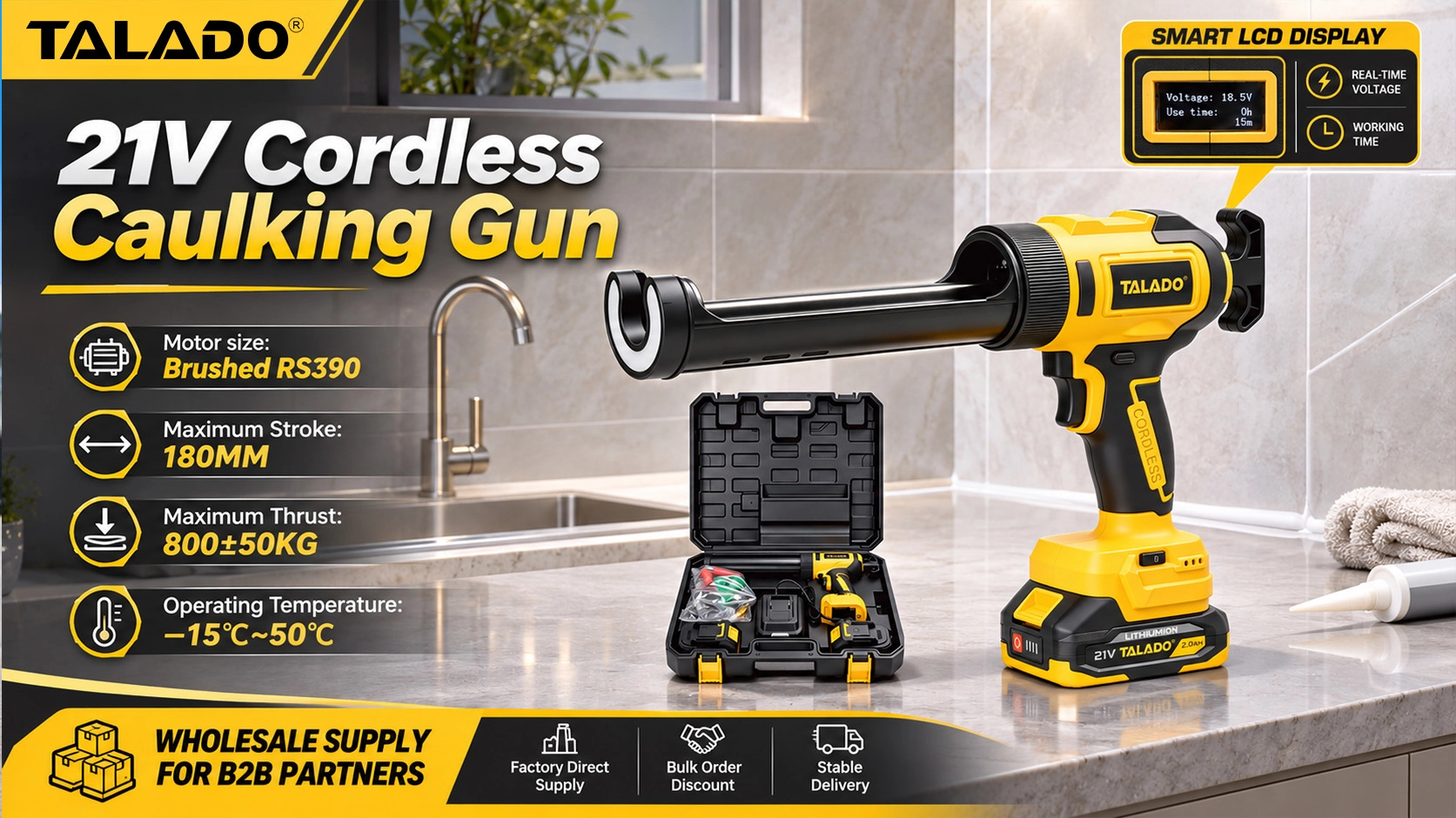
The TALADO ML‑G003 21V cordless caulking gun is engineered to support working temperature ranging from ‑15℃ to 50℃. However, hardware distributors and end‑users still need to follow standardized winter‑use specifications to give full play to its performance. This article covers winter operating skills, battery protection, sealant selection and daily maintenance, helping your teams finish joint‑sealing tasks stably in frigid conditions.
| Item | Specification Note for Winter Use |
|---|
| Applicable Ambient Temperature | ‑15℃ ~ 50℃ |
| Model | ML‑G003 21V Cordless Caulking Gun |
| Max Thrust | 800kg (thrust drops slightly under‑10℃) |
| Display | LCD real‑time voltage monitoring (critical for cold‑weather battery judgment) |
| Bare Tool Weight | 1.15 KG |
| Reminder | Sealant viscosity rises sharply in low temperature; choose cold‑resistant sealant |
Common Winter‑time Pain Points for Cordless Caulking Gun
Before getting into operation guidance, let’s look at typical complaints that frequently appear in cold‑site jobs:
- Sealant becomes thick and sticky, extrusion speed gets slower even on maximum speed setting
- Lithium‑ion battery runtime drops obviously; power drains faster outdoors
- Gearbox and plunger movement turns sluggish under freezing temperature
- Ordinary sealant cannot cure properly, resulting in poor sealing effect
- Residual frozen sealant solidifies inside nozzle and barrel, causing blockage
These problems are not entirely product defects. Most of them are caused by mismatch between operating habits, consumable selection and cold weather. Correct winter care will greatly reduce failure rate and product returns for B2B buyers.
Practical Operation Guidance Under ‑15℃ Low‑temperature Conditions
1. Sealant Pre‑treatment & Consumable Selection
✅ Prioritize cold‑weather formulated sealant / low‑temperature resistant silicone.
General‑purpose sealant will thicken heavily below 0℃, increasing load on the motor.
✅ If regular sealant must be used, store sealant cartridges indoors above 5℃ before on‑site use.
Do not directly apply sealant taken from freezing trucks or outdoor storage.
✅ Replace thicker‑sized nozzles appropriately. Narrow nozzles will raise extrusion resistance in cold weather.
2. Speed & Thrust Adjustment Skills
🔹 Do not run the caulking gun at full‑speed continuously from startup.
Start from low‑speed gear for pre‑extrusion to release cold‑state internal resistance.
🔹 Observe real‑time data on the LCD display.
If voltage drops rapidly under load, pause work instead of forcing continuous extrusion to avoid motor overload.
🔹 For high‑viscosity winter sealant, intermittent trigger operation is recommended rather than long‑time continuous pressing.
3. Lithium‑ion Battery Winter Protection
Lithium‑ion batteries are sensitive to low temperatures. Even though the tool can work at‑15℃, batteries need extra care:
- Keep spare batteries inside thermal‑insulated tool bags; avoid leaving batteries overnight in outdoor cold vehicles.
- Charge batteries in indoor environment (5‑25℃). Never charge frozen cold batteries directly. Let cold battery return to room temperature before charging.
- When LCD shows sharp voltage drop under‑10℃, swap to fully charged spare battery in time. Do not drain the battery completely in freezing condition, which will shorten battery cycle life.
4. On‑site Machine Operating Habits
- Avoid long‑term idle exposure of the whole tool under‑15℃. Take it back to vehicle or tool box during long work breaks.
- Prevent snow, ice and melting water from seeping into motor housing and LCD screen interface.
- Do not knock or strike the gun body in cold weather; plastic components become more brittle at low temperature.
Post‑job Winter Maintenance Checklist (Important for Service Life)
After finishing winter outdoor sealing work, incomplete cleaning is the top cause of tool damage. Follow this checklist for every use in cold seasons:
- Immediately clear residual sealant inside plunger, barrel and nozzles before leftover material freezes and hardens. Frozen solidified sealant will jam mechanical structures permanently.
- Remove the battery and store separately in dry indoor place, not together with cold tool body.
- Clean scraper accessories, wipe off moisture and frost, and place inside BMC storage case.
- If sealant residue has already partially cured, do not force trigger; disassemble and clean manually instead.
Check gearbox condition on a regular basis. Cold environment may thicken internal grease; perform periodic maintenance for heavy‑frequency commercial use.
💡 Tip for B2B Distributors: You can attach this winter‑care tip sheet as auxiliary marketing material in your product package, helping end‑users operate correctly and lower your after‑sales volume.
Suitable Winter Application Scenarios for ML‑G003
Even under low‑temperature environment, this caulking gun fits these commercial projects with proper operation:
- Exterior window & door gap sealing in cold regions
- Outdoor wall joint waterproofing renovation
- Facade maintenance for industrial buildings
- Pipe joint sealing for construction sites
- Cold‑area kitchen & bathroom renovation sealing (indoor heated environment preferred
Troubleshooting: Quick Solutions for Common Cold‑weather Faults
| Phenomenon | Possible Cause | Recommended Solution |
|---|
| Slow extrusion even at max speed | Sealant too cold & high viscosity | Warm sealant cartridge indoors; enlarge nozzle aperture |
| Sudden voltage drop on LCD | Battery low‑temperature attenuation | Swap pre‑warmed spare battery |
| Plunger stuck, cannot push forward | Residual sealant frozen & solidified | Stop operation, disassemble and clean frozen residue |
| Motor hums but no output power | Over‑load protection triggered | Rest tool for several minutes, adjust to low‑speed start‑up |
Conclusion
‑15℃ low‑temperature working capability makes the TALADO ML‑G003 21V cordless caulking gun stand out among many competitors on the power‑tool market. Nevertheless, hardware performance can only be maximized with matching winter operation, consumable selection and maintenance habits.
For B2B partners including importers, hardware wholesalers and tool retailers, popularizing cold‑weather usage knowledge to your mechanic and contractor clients will reduce mis‑operation‑caused returns, improve end‑user satisfaction and enhance market reputation of your product line.
If you need winter‑use technical leaflets, product images or bulk‑order quotation for ML‑G003 cordless caulking gun, please contact our sales team.