How Does a Brushless Cordless Impact Wrench Work?
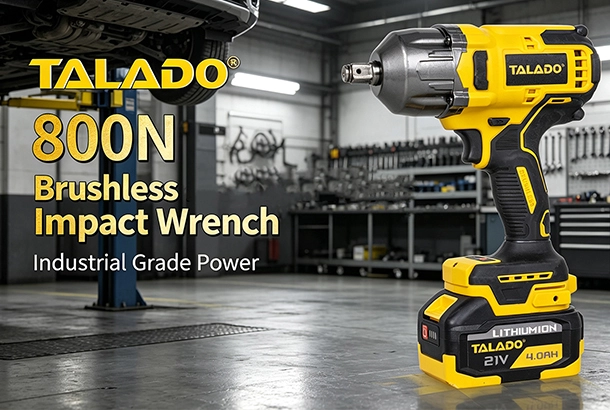
A brushless cordless impact wrench is designed to deliver high torque without requiring a direct connection to an air compressor or power outlet. By combining a battery-powered motor with a mechanical impact mechanism, the tool can provide repeated torque pulses that help loosen and tighten demanding fasteners.
For automotive repair, equipment maintenance, and other fastening applications, understanding how this type of tool works can help users choose the right wrench and use it more effectively.
1. How Does the Brushless Motor Work?
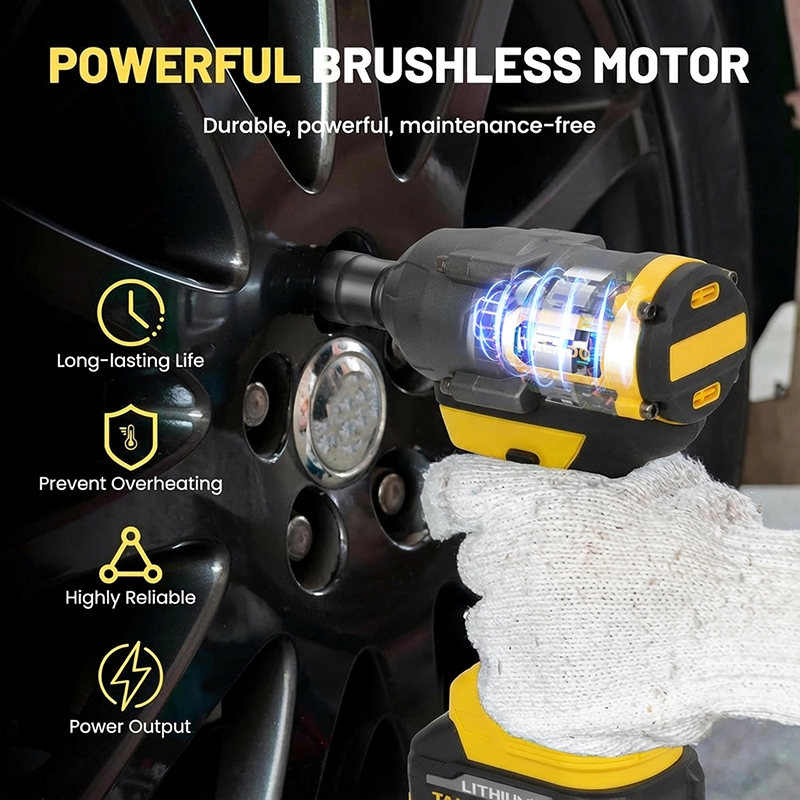
The brushless motor is one of the key technologies used in many modern cordless impact wrenches. Unlike a traditional brushed motor, it does not rely on physical carbon brushes to transfer electrical current to the rotating part of the motor.
Instead, electronic controls regulate the current supplied to the motor windings and control the rotation of the motor. This design eliminates brush-to-commutator contact and reduces one source of mechanical wear.
A brushless motor can provide several practical benefits:
- Reduced mechanical wear
- Efficient power conversion
- Long operating life
- Less maintenance associated with brush replacement
- Consistent motor performance
For a cordless impact wrench, efficient motor operation is particularly important because the available energy comes from a rechargeable battery. A brushless motor can therefore be a useful choice when users need a combination of portability, power, and operating efficiency.
2. How Does the Impact Mechanism Produce High Torque?
The motor itself is not the only reason an impact wrench can loosen stubborn bolts. The impact mechanism also plays an important role.
During operation, the motor rotates an internal drive mechanism. Instead of continuously applying all of its rotational force directly to the fastener, the impact mechanism stores and releases rotational energy in repeated pulses.
When resistance from the fastener becomes high, the hammer mechanism engages with the anvil and delivers a rapid impact. This process happens repeatedly, producing a series of torque pulses.
This operating principle is different from simply applying constant rotational force. The repeated impacts help the wrench deal with fasteners that require higher loosening force.
The basic power transmission can be understood as:
Battery → Motor → Drive Mechanism → Hammer and Anvil → Socket → Fastener
This combination allows a compact cordless tool to provide substantial fastening and loosening force.
3. Why Is an Impact Wrench Effective for Removing Bolts?
Bolts and nuts can become difficult to remove because of corrosion, over-tightening, contamination, thermal cycling, or prolonged service. A conventional hand wrench may require considerable physical effort when dealing with these fasteners.
An impact wrench approaches the problem differently.
The repeated torque pulses generated by the impact mechanism can help overcome the initial resistance between the fastener and its mating surface. Because the force is delivered in rapid impacts, the tool can continue applying rotational energy without requiring the user to manually generate the same level of torque.
This makes a brushless cordless impact wrench useful for applications such as:
- Automotive fastening and maintenance
- Wheel and tire-related maintenance
- Machinery maintenance
- Equipment assembly and disassembly
- General fastening and repair work
However, an impact wrench should not automatically be used for final torque-critical tightening. Where a specific tightening torque is required, a calibrated torque wrench may be needed for final verification.
4. What Makes a Cordless Design Useful?
Another important feature is the cordless configuration. A cordless impact wrench operates from a rechargeable battery, eliminating the need for a power cable or compressed-air hose during normal operation.
This can make the tool easier to move around a vehicle, workshop, or job site. It is especially convenient when fasteners are located away from fixed power sources.
The 21V Cordless Wrench 600N from Meile Tool is positioned as a cordless fastening tool for automotive-related applications. Its product positioning provides an example of how battery-powered fastening tools can combine portability with impact-driven operation.
5. Brushless Motor + Impact Mechanism: Why the Combination Matters
The performance of an impact wrench comes from the interaction between its electrical and mechanical systems.
The brushless motor provides the rotational power needed to drive the mechanism, while the impact assembly converts that rotation into repeated torque pulses. The battery supplies electrical energy, and the control system manages motor operation.
Each component therefore has a different role:
| Component | Main Function |
|---|
| Battery | Supplies electrical energy |
| Electronic control | Regulates motor operation |
| Brushless motor | Converts electrical energy into rotation |
| Drive mechanism | Transfers rotational movement |
| Hammer and anvil | Generate impact torque |
| Socket | Transfers torque to the fastener |
This combination allows a cordless impact wrench to remain relatively compact while providing the torque required for demanding fastening and loosening operations.
6. Choosing the Right Brushless Cordless Impact Wrench
When selecting an impact wrench, users should consider more than torque alone. The appropriate tool depends on the type of fasteners, working environment, frequency of use, and required portability.
Important factors include:
- Motor type
- Battery voltage and capacity
- Torque output
- Impact mechanism
- Tool weight and ergonomics
- Socket compatibility
- Intended application
- Charging and battery availability
For automotive fastening applications, for example, users may prioritize torque and portability. For lighter maintenance tasks, a more compact tool may be preferable.